
Interview conducted by Tamar Mgebrishvili
Andrew Jefford is one of Britain’s most distinguished wine writers, journalists and experts. He has been writing about wine since 1988 and contributes to influential publications such as Decanter and The World of Fine Wine. He is co-chair of the Decanter World Wine Awards and an active advocate for wine education.
Vinoge.com presents an exclusive interview with Andrew Jefford. In this conversation, Jefford explores one of the key challenges facing the contemporary wine world: why wine is losing some of its appeal among consumers, and how the wine industry should respond to these changes. From health messaging and emerging consumer trends to the ways wine is communicated and its broader cultural significance, his reflections revolve around one central idea: the future of wine depends on more than quality alone. It also depends on communicating its uniqueness, origins, history, and deep connections with people and places. A central theme of the interview is Georgian wine - its potential, the challenges it faces today, and Jefford’s perspective on how these challenges might be addressed.
- This year, you are the chair of the jury of the International Saperavi Competition in Georgia, which is a very important fact. Saperavi is often talked about as a variety that has the potential to go beyond Georgia’s borders and become a grape variety of international importance, while the wines made from it establish a place among world-class red wines. How realistic does this prospect seem to you, and in your opinion, how correctly and effectively is the Georgian wine industry managing to present Saperavi’s potential on the international stage today?
- I’m very happy to chair the International Saperavi Competition – as I love this variety and would like to see it flourish internationally. I love deep, structured reds. I believe that tannins in red wine are not only the reason for the physiological health benefits that my body derives from moderate red-wine drinking (and which complement the psychological benefits of socialized recreation, discussion and off-screen time that wine can help bring), but they are often the source of the most profound levels of pleasure that acknowledged ‘fine wines’ bring in mealtime contexts. What do the world’s greatest red wines – from Bordeaux, Burgundy, the Rhône Valley, Piedmont, Tuscany, Napa, Rioja and the Douro/Duero valley all have in common? Significant structure derived from plant tannins (principally from skins, but on occasion also stems and pips.) Yes, even Burgundy – some sense of tannic structure is what often distinguishes Burgundian Pinot Noir from its competitors grown elsewhere. Saperavi makes magnificently structured red wines.
Saperavi is a teinturier variety; indeed for me it’s the greatest teinturier in the world (greater than Alicante Bouschet, the nearest rival).
Saperavi can, moreover, be produced in many different styles – some overwhelmingly fruity (it doesn’y have to be fiercely structured). Its fruit qualities are exciting and explosive.
I’ve also noticed that it can shed its structure relatively swiftly in bottle and thus acquire aged characteristics more rapidly than wine made from other ‘sturdy’ red varieties: another advantage.
So for me the variety unquestionably has the potential to “establish a place among world-class red wines”. There are, though, some challenges.
One significant challenge is that “big reds” are now internationally out of fashion. So too are deeply coloured reds, notably ripe reds, oaky reds and low-acid reds.
Actually I have a contempt for fashion and have strived for 70 years to go against fashion; ‘fashion’ for me is another word for stupidity and sheep-like behaviour. It’s also a way of extorting money from people unnecessarily, and brainwashing and ultimately humiliating them. So: no fashion!
But I have to accept that I’m in the dissident minority here. Most people follow and swallow fashion. The kind of wine that Saperavi makes is unfashionable at present. That’s a challenge.
I believe that all fashions eventually change (in a circular direction!) and people will get bored with the light, acidic, low-alcohol and ‘intellectual’ red wines that are currently in fashion. Humans are conditioned to enjoy ripeness in the foods they eat and the drinks they drink. Balanced ripeness -- but ripeness all the same. And I believe that all fine-wine drinkers stick with structured reds, because these are what work best with food, and it is in these sorts of wine that red-wine profundity lies.
I should also say that I am opposed to ‘varietalism’. This is the idea that a wine’s style, character and sensual appeal is primarily based on the variety it is made from. Style and sensual appeal in fact derive from place and season. The variety is simply the tool used to interpret place and season. Cabernet Sauvignon from Pauillac and Cabernet Sauvignon from Rutherford in Napa are very different sorts of fine red wine; ditto Malbec from Cahors and Mendoza; ditto Tannat from Madiran and Uruguay, ditto Sauvignon Blanc from Sancerre and Marlborough.
Which is ‘the true Cabernet’ – Pauillac or Napa? Answer: neither … or both. What you’re drinking is Pauillac or Napa.
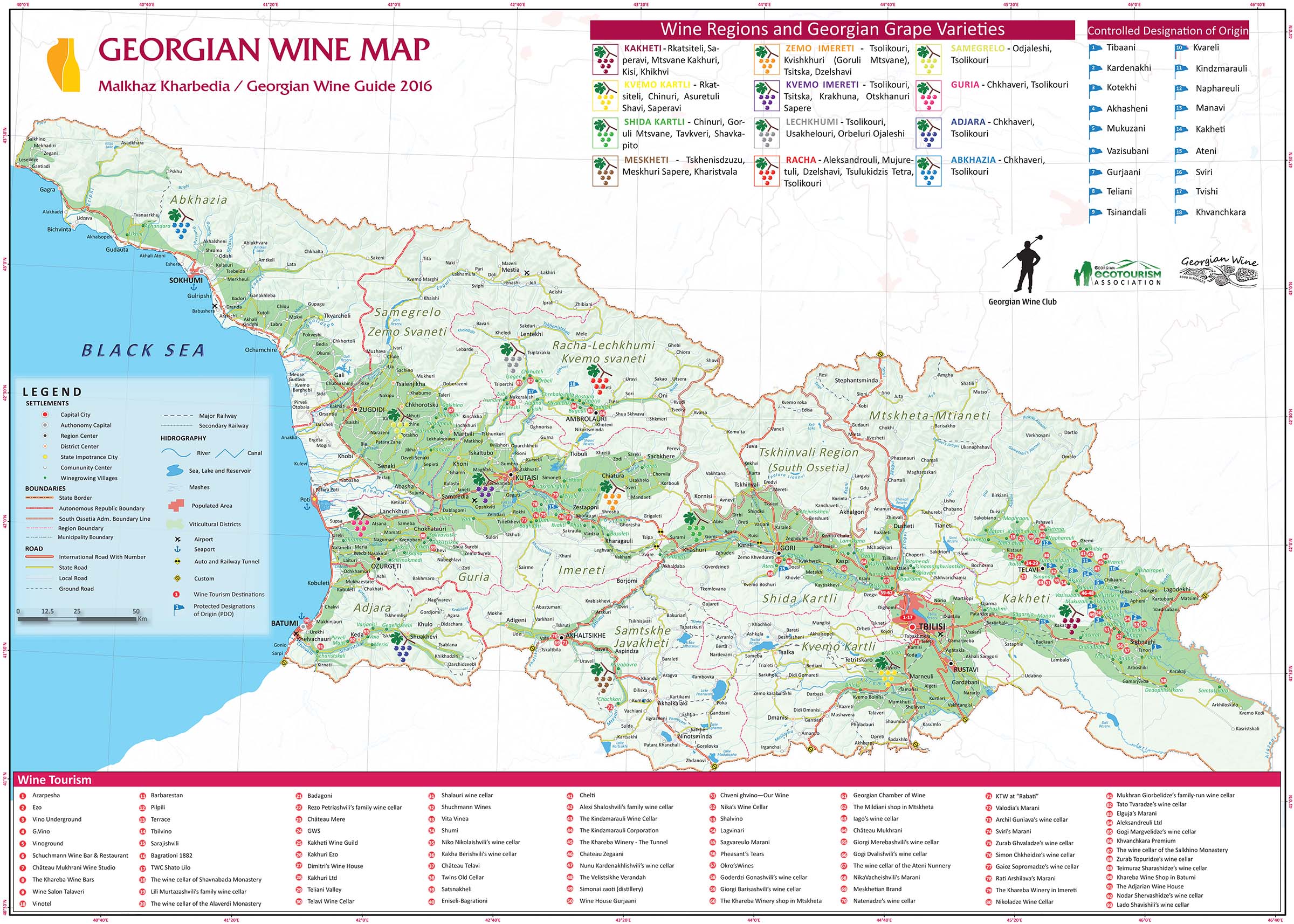
You can see this clearly if you compare Saperavi produced in different regions of Georgia. Saperavi from Kakheti is different to Saperavi from Kartli, Imereti or Racha-Lechkhumi. (Production techniques have something to do with that, but they only exist to optimize what nature is giving.)
Until Saperavi is used more widely internationally, we have no idea at all as to what it will do, how well it will work or what its wines will be like. It might be a great tool or a terrible tool in most of the wine-growing sites of the world – we just don’t know yet.
I don’t think it’s Georgia’s job to try to promote Saperavi on the world stage. All that Georgia and Georgian winemakers should do is try to produce the most delicious, subtle, nuanced, textured and aromatically compelling wines that they can, in each of their different growing locations, using Saperavi. If Georgia’s great wines emerge on the world stage and command high prices, inspire long storage and are eventually traded and sought-after as mature wines on fine-wine auction markets in London, New York and Hong Kong, then the world will begin to experiment with Saperavi, and maybe we will then discover its potential is as a tool for unlocking distinguished wine-making sites.
The idea behind our competition is to welcome all such wines, judge them fairly, and in doing so open the world’s eyes to the set of possibilities that Saperavi represents.
- Today, amber wines made with prolonged skin contact are attracting increasing interest around the world and can be considered one of the major trends. However, for a significant part of Western consumers, this style is still a relatively new experience. In your observation, what might be the main barrier preventing Western consumers from fully understanding and embracing Georgian amber wine? And, on the other hand, what creates the particular interest and appeal that is making amber wines increasingly popular in the West?
- I will answer the second question first. I’ve already stressed the importance for me of structure in red-wine – for its healthfulness, for its food-friendliness and for the depth of its sensual appeal. Amber wines are skin-contact whites … or, if you prefer, whites with some level (from trace to significant) of tannic presence or structural intrigue. For me and for many older drinkers, this kind of wine had been missing for most of our drinking lives. Now we have it once again: wonderful! It was “the missing sixth”. We had red, white, sparkling, rose and fortified wines – but we didn’t have amber; it had been lost in the western European wine-making tradition. Now we have it back: thank you, Georgia.
For younger drinkers, it is “a different style” to the other five main genres – so it brings something extra to their drinking repertoire. And for those interested in what is called ‘natural wine’ (meaning low-intervention wine), amber styles are perhaps the primary expression for white-wine grapes – because you are using the whole grape and sometimes even the whole bunch, and you are not physically intervening in the process until the point at which fermentation has definitively concluded.
The barrier (to go back to the first part of the equation) is that most global wine-drinkers have never been exposed to such wines before, so they “taste strange”. They bring the shock of the new. They are an acquired taste – and the taste takes time to acquire.
I should also say that making such wines without the compromise of spoilage or deviation takes patience, close attention and skill. There are failures.
And it is also a style with a significant aesthetic repertoire, from very delicate (‘barely amber’) to deep and forceful. Perhaps this makes amber wines difficult to understand – though one might also say the same thing about red wines and ‘skinless’ white wines in general.
- Georgia is historically known as the “cradle of wine,” which is, to some extent, a powerful marketing message. However, in today’s modern wine market, history alone is probably no longer enough. In your opinion, what is the main mistake Georgian winemakers make when presenting qvevri wine to the international market? It is particularly interesting that, alongside the growing popularity of qvevri wine, large wine companies are also actively turning to its production. How authentically do they represent the essence and tradition of qvevri wine? In your opinion, should qvevri wine remain primarily the hallmark of small wineries, or is its wider commercialization an important opportunity to increase the international recognition of Georgian wine?
- The biggest mistake is putting defective or spoiled qvevri wine on to the market as “authentic”. Georgian winemakers (either individually or communally) need to ensure that this does not happen.
It’s also important that there’s an accepted international standard for use of the term ‘qvevri’ on a wine label. My understanding is that there is a PGI for ‘qvevri’ – meaning a vessel made in Georgia from authentic Georgian raw materials (clay), but no requirement either that the qvevri should be buried, or that it should be used for skin-contact wines. I would hope that Georgia could press for the international acceptance of both requirements if this Georgian word is to be used about wines produced outside Georgia.
I have no problem at all about large companies producing skin-contact wines from authentic Georgian qvevris buried in earth anywhere on Earth. I’m very much opposed to the idea that it should be the preserve of ‘small wineries’ alone, or indeed Georgian wineries alone.
Think about it: the more such wines there are, and the more widely they’re produced around the world, then the more the world’s drinkers will be thinking about Georgia, will be curious about Georgia, will want to learn about Georgia, will want to come to Georgia and will want to buy the finest examples of Georgian classical winemaking, both red and white.
- You describe the progress of the wine industry in Georgia over the past decade as particularly rapid. However, rapid development always comes with certain risks. In your observation, what is it that the Georgian wine industry must preserve at all costs during this process, and what is at risk of being lost as traditional winemaking moves closer to the modern international wine world?
- I’ve already said that I don’t think that defective or spoiled wines should be exported as examples of Georgian classical winemaking. This is very important. We need great qvevri wines to travel the world as ambassadors for Georgia’s wine culture.
Georgian names (of varieties, of regions and of winemaking entities) are complex for non-Georgians to read and to retain. This challenge isn’t unique to Georgia, but it is a serious challenge. Every producer of Georgian wine needs to think very seriously about the way in which they present their wines and their stories to overseas markets, and to try to find ways to do this as simply, as memorably and as beautifully as possible. Aesthetics and communication are very significant elements of wine marketing.
90-95% of Georgian wine is not produced in qvevris. How good are these other wines? In my opinion, there is significant room for improvement.
- Non-skin-contact Georgian white wines are, at present, over-homogenous, produced in reductive styles that often seem to minimize both varietal and regional expression.
- This is true although to a lesser extent of conventionally vinified Georgian red wines, too.
- Too many Georgian red wines show excessive oak character.
- Acidification is almost always a bad idea: the worst stratagem of industrial winemaking.
- Never be afraid of tannin if ripe grapes in peak condition from distinguished sites are ready to surrender this during gentle vinifications.
It’s very important that Georgian winemakers should benchmark their own wines against international competition as widely as possible. Qvevri may be the torchbearer, but there is a very large legion following behind. International drinkers are curious about Georgian regions and the country’s astonishing varietal patrimony, but the best way to ensure that this is more than a passing fad is to deliver exciting, pure, non-industrialised wines that fully express their inherent differences with a wide spectrum of hues, of fruit characters, of aromatic complexity, of textures and of balances.
- Are there any rare Georgian grape varieties that have caught your attention? Is there a particular rare Georgian variety that you believe wine lovers and professionals should be paying more attention to today?
- Many – but I am reluctant to pull out some names and not others, because developmentally I believe there is much work ahead before we will really know where the greatest wine-making sites in Georgia are (this is the most important question) and after that know which variety or varieties are the best tools to use to express that potential excellence. It’s also possible that Georgia’s greatest wines one hundred years hence will come from blends and not be varietal wines.
I can’t repeat enough that the variety per se doesn’t matter. All that matters is whether the variety is (or the varieties are) the best possible choice for the vineyard.
And yes, I realise that varieties are the way that most people ‘learn wine’ and so are an important marketing tool – but from the international perspective remember that most global wine drinkers have no idea at all about Georgian varieties, are unlikely to be able to pronounce Georgian variety names, and won’t remember Georgian variety names, so making a big play of the variety name on a front label is a waste of time. (Saperavi is the only possible exception to this rule.) So
a) make the best wine you can, and then
b) tell people that it comes from Georgia and
c) give it a beautiful label. Job done.
Region and qvevri (if relevant) might also be added for the geeks. Everything else is for the back label or the website accessed by smartcode (for the ultra-geeks or the innocently curious).
- Although the international recognition of Georgian wine has grown significantly in recent years, establishing a firm presence in Western markets is still not easy. What is the main challenge Georgian wine faces today in the Western market?
- Intelligibility (the difficulty of names) and in some cases strangeness of aroma and flavour. Aesthetics (label design, bottle quality). Possibly some confusion around Georgia and Russia, or Georgia (the nation) and Georgia (the US state).
- Finally, I would like to ask you about a very interesting and pragmatic topic. Recently, declining wine sales have become a significant challenge for many markets. What are the main reasons behind this trend, and how should the wine industry respond to changing consumer behaviour and demands?
- Big question! I’ll try to keep it as short as I can. A few reasons first.
- Health messages, and notably the IHO declaring that cancer risk ‘begins with the first sip’ of an alcoholic beverage. This message is entirely uncontextualized by risk analysis (minute compared, for example, to driving a car down a street) and comes without advice about psycho-social benefits that usually accompany the consumption of alcoholic beverages.
- Increasing interest in health and fitness means that it is now “cool to abstain” for fitness purposes.
- Wine-drinking is now unfashionable. We are onto the third US Presidential term where the office-holder is an abstainer, and the politics of the extreme right tends to emphasize abstention or the consumption of soft drinks. De-socialization, auto-radicalization by social media and screen-addiction shuts victims off from the healthful use of wine and other alcoholic drinks, which are essentially social activities.
- Cannabis legalization and frenzied creativity in gamified or novelty beverages have increased the choice of stimulants significantly.
- Recent developments in wine-media coverage (in particular the rise of wine criticism, and the extensive use of bottle shots, tasting notes and wine scores) has made the subject boring and geek-infested.
How should wine creators respond?
- Keep making better wines.
- Emphasis mealtime consumption and the benefits of this.
- Keep wine communication simple at point of sale. (Use smart codes to be as informative online as possible.)
- Make bottles of wine beautiful to look at, to hold and to own.
- Emphasize the longevity of wine creation (8,000 years in Georgia’s case) and its intimate connections to the deepest traditions of European culture. This makes wine trustworthy, sanctioned by many centuries of use.
- Emphasize wine culture to those open to this and interested in this.
- Emphasize origins to those open to this and interested in this. Wine connects us to places on earth and enables us to love places on earth.
- Emphasize difference. It is difference that people love about wine, not “excellence”. (Indeed excellence in wine doesn’t objectively exist. It only exists subjectively.)
© wineclub/vinoge.com
 Print
Print